Why and When Should You Throw Away a Plastic Cutting Board?

Time:2026-11-25 Author:Charlotte
0%

When should you throw away a plastic cutting board? The answer is usually visible beneath your knife: deep grooves, cracks, warped edges, or stains that remain after washing. These marks can trap food and make thorough cleaning harder. USDA’s Food Safety and Inspection Service gives a practical rule: “Replace cutting boards that have become excessively worn or have hard-to-clean grooves.” That advice is more useful than following an arbitrary replacement schedule.

Research by food microbiologist Dr. Dean O. Cliver and colleagues examined how bacteria behave on wood and plastic cutting boards. Their work is a reminder that material alone does not guarantee safety. Condition and cleaning matter, too. The CDC estimates that foodborne illness affects about 48 million people in the United States each year; that figure covers many causes, not cutting boards specifically. Still, a damaged board is an avoidable weak spot in a busy kitchen.

Look closely. If a plastic board feels rough, has a split, or holds residue in its knife tracks, replace it. A quick rinse may not reach those narrow grooves. Keep raw-meat preparation separate from ready-to-eat foods, and wash and sanitize boards between uses. No board lasts forever. And sometimes, a board that looks “mostly fine” deserves a second look.
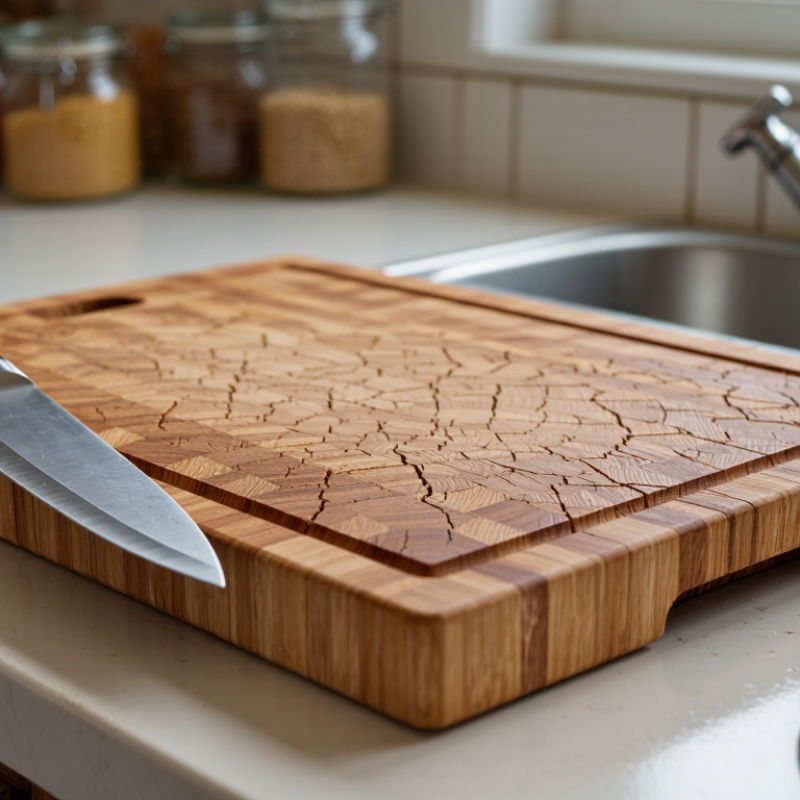
Why and When Should You Throw Away a Plastic Cutting Board?

How Plastic Cutting Boards Wear Down With Use

A plastic cutting board wears down a little each time a knife crosses it. At first, the marks are shallow and easy to miss. Over time, they form a network of grooves that can trap food residue and become harder to scrub clean. The surface may also turn rough, stained, or uneven. A board that rocks on the counter or has cracks can be difficult to clean thoroughly. There is no perfect visual test, and age alone is a poor guide. Look closely after washing, especially where you usually chop.

Tips: Replace the board when deep grooves remain dirty after careful washing, or when it is cracked, warped, or shedding plastic. Follow its care instructions, since not every board is dishwasher-safe. A quick rinse is not enough after cutting raw meat; wash it promptly with hot, soapy water.

Small scratches do not automatically mean a board must go. But when the knife marks feel deep under your fingertips, or the surface stays rough despite cleaning, it may be time to let it go. I would not wait for a board to split in half. That is an imperfect threshold, but visible wear gives you a practical reason to replace it.

What Damage Can Make a Board Unsafe

A plastic cutting board rarely becomes unsafe from one faint scratch. The concern is deep, crowded grooves that a sponge cannot reach. Knife cuts can trap food residue, especially after preparing raw meat or fish. Washing may remove what you can see, but a badly scarred surface is harder to clean reliably.

That matters.

Look for cracks, splits, and chipped edges. These can hold moisture and debris, and may worsen with repeated washing. A board that flexes, rocks, or has curled edges is also difficult to use safely. Replace it if damage creates crevices you cannot scrub clean.

A stain alone is not proof of danger, though a persistent odor deserves attention. Smell is a clue, not a test.

I used to think a quick rinse was enough for a board with shallow marks. It wasn’t a great assumption. Wash boards with hot, soapy water after use, and sanitize them according to their care instructions when appropriate.

If deep grooves remain grimy, or the surface feels rough and shredded, stop using it for food. There is no perfect visual cutoff; judgment can be awkward.

When damage makes thorough cleaning doubtful, replacing the board is the safer choice.

How Board Condition Affects Food Safety

A plastic cutting board can look clean while its surface tells a different story. With repeated chopping, knife cuts form narrow grooves where food residue may remain. Those scratches can make thorough cleaning harder, especially after handling raw meat or fish. A quick rinse is not enough.

Wash the board with hot, soapy water after each use, paying attention to deep cuts and edges. Sanitize it when appropriate, following the care instructions for the board and sanitizer. Keep separate boards for raw animal foods and ready-to-eat ingredients, such as salad vegetables. That matters. If raw-meat juices reach a grooved board, wiping it with a cloth may spread residue rather than remove it.

Replace a board when it has deep, extensive scoring, cracks, or warping that prevents it from sitting flat. These defects can trap debris and make cleaning less reliable. A faint stain alone does not prove the board is unsafe, and a strong odor deserves attention but is not a precise test. There is no perfect visual rule. Check the surface under good light, and be honest: if grooves are difficult to scrub clean, retiring the board is the safer choice.

When to Replace a Plastic Cutting Board

Replace a plastic cutting board when deep knife grooves remain after washing, or when cracks, peeling, and rough patches appear. These cuts can trap food residue and make the surface harder to clean. USDA Food Safety and Inspection Service guidance says to discard boards that are excessively worn or have grooves that are difficult to clean. There is no reliable universal replacement date; condition matters more than age. Deep grooves matter. A board used daily for raw meat may wear faster than one used occasionally for bread, so inspect it regularly.

A clean-looking surface is not always an easy-to-clean surface. Run your fingers over the board after washing: if the blade marks feel rough or hold visible residue, consider replacing it. Also discard boards that warp and rock on the counter, since they can slip while you chop. CDC estimates that 48 million people in the United States get sick from foodborne illness each year. That figure is not specific to cutting boards, but it underscores why cleanable food-contact surfaces matter. I’d be cautious about treating a calendar as the answer; it isn’t.

Tips: Keep separate boards for raw meat and ready-to-eat foods. Wash with hot, soapy water after use, then air-dry fully. If stains remain but the surface is smooth and intact, a stain alone does not necessarily mean replacement.

Why and When Should You Throw Away a Plastic Cutting Board? — When to Replace a Plastic Cutting Board
Condition What to Look For Recommended Action Why It Matters Timing
Deep, extensive knife grooves Cut marks are numerous or deep enough that the surface is difficult to scrub clean. Replace the board. Food residue and bacteria can be harder to remove from heavily worn surfaces. As soon as the grooves cannot be cleaned effectively.
Cracks, splits, or broken edges The board has a crack, split, or damaged area that traps food or liquid. Replace the board. Damaged areas are difficult to clean thoroughly and may worsen with use. When damage appears; do not keep using a board that cannot be cleaned well.
Warping or an unstable surface The board rocks, slides, or no longer sits flat on the counter. Replace it if it cannot be made stable during use. An unstable board can increase the risk of a knife slipping and causing an injury. Before the next use if it cannot be secured safely.
Persistent odor or discoloration A strong smell or stain remains after thorough washing, especially when accompanied by deep cuts or damage. Inspect the surface; replace it if residue is trapped or the board cannot be cleaned properly. Odor or staining alone does not always mean a board is unsafe, but it can point to trapped residue or wear. After cleaning and inspection; replace if the problem persists and cleaning is ineffective.
Surface peeling, flaking, or melting Pieces of plastic are lifting, coming loose, or the board is heat-damaged. Stop using and replace the board. A deteriorating surface may contaminate food and is difficult to clean reliably. Immediately when peeling, flaking, or melting is noticed.
Board is worn but still smooth and intact Minor shallow marks are present, but the board remains stable and can be washed thoroughly. Continue using it with proper cleaning; inspect it regularly. There is no universal replacement schedule. Condition and cleanability are more useful guides than age alone. Replace when wear makes the board difficult to clean or use safely.
After handling raw meat, poultry, seafood, or eggs The board is used for raw animal foods but has no cracks or hard-to-clean grooves. Wash with hot, soapy water and sanitize when appropriate; keep it separate from ready-to-eat foods. Cleaning and preventing cross-contamination are important; raw-food use by itself does not mean the board must be discarded. Clean promptly after each use; replace only if the board is damaged or cannot be cleaned effectively.

How to Slow Wear and Extend Board Life

A plastic cutting board lasts longer when you treat its surface gently. Use a sharp knife and let the blade do the work; pressing hard can leave deeper cuts. Rotate the board often, or use both sides if each side is intended for food preparation. Wash it promptly with hot, soapy water, then dry it upright so moisture does not linger underneath. Check the care instructions before using a dishwasher, since heat can warp some boards. Small habits matter.

Not every scratch means the board needs replacing. Light marks and faint stains can be cosmetic, and scrubbing harder may only roughen the surface. Deep grooves are different: food residue can collect in them, and they may become difficult to clean thoroughly. Replace a board if it is cracked, badly warped, or scored so deeply that cleaning no longer reaches the cuts. It is easy to keep one too long because it still looks usable. Look closely in bright light.

Tips: Keep separate boards for raw meat and ready-to-eat foods. Avoid leaving a board beside a hot pan or soaking it for hours. Wash both sides, even when only one was used. If a groove catches your fingernail, inspect it carefully.

FAQS

What signs mean a plastic cutting board should be replaced?

Replace it when deep grooves remain dirty after careful washing. Cracks, peeling, rough patches, or warping are warning signs too. Deep grooves matter.

Does a board have a fixed replacement date?

No. There is no reliable universal date. A board used daily may wear faster than one used occasionally. Condition matters more than age.

Are small knife marks enough reason to replace a board?

Not necessarily. Shallow scratches do not automatically mean the board must go. Check whether the marks feel deep or hold visible residue.

How can I check whether the surface is still cleanable?

Wash the board, then inspect it under good light. Run your fingers over the usual chopping area. If grooves feel rough or stay dirty, consider replacing it. This test is not perfect.

How should I clean a board after cutting raw meat?

Wash it promptly with hot, soapy water. Scrub the grooves and edges carefully. A quick rinse is not enough.

Should I use separate boards for different foods?

Yes. Keep separate boards for raw animal foods and ready-to-eat ingredients, such as salad vegetables. That small habit can help prevent residue from spreading.

Do stains or odors mean the board is unsafe?

A stain alone does not prove the board is unsafe if its surface is smooth and intact. A strong odor deserves attention, but it is not a precise test.

Why replace a board that rocks on the counter?

A warped board may slip while you chop and can be harder to clean thoroughly. I would not wait for it to split in half; that is a rough threshold, but it feels practical.

Conclusion

Plastic cutting boards gradually wear down as knives leave grooves across the surface. Over time, these marks can become deep, rough, or difficult to clean, while cracks, chips, warping, and discoloration may signal further deterioration. A worn board can hold food residue and moisture in damaged areas, making thorough cleaning harder and increasing the chance of cross-contamination between foods.

When should you throw away a plastic cutting board? Replace it when deep grooves remain after washing, or when it is cracked, split, badly warped, or has pieces breaking off. Minor surface marks do not always mean a board is unsafe, but its condition should be checked regularly. To slow wear, use a suitable knife, avoid excessive force, clean the board promptly, and let it dry fully. Turning it over and using both sides can also distribute wear. With regular care and timely replacement, a cutting board can remain a useful, dependable part of food preparation.

Charlotte

Charlotte

Charlotte is a seasoned marketing professional with a deep understanding of the company's portfolio and a passion for elevating its presence in the market. With a keen eye for detail and a commitment to excellence, she ensures that our professional blog is regularly updated with insightful articles......