Is it safe to cut baby food on plastic cutting boards? In many kitchens, yes, if the board is food-grade, clean, and in good condition. The material alone is not the whole story. Deep knife grooves can trap food residue and make thorough cleaning harder, even when the surface looks tidy. A board with rough, stained, or difficult-to-clean cuts deserves a closer look.
For a small meal, imagine slicing a peeled pear or chopping soft, cooked vegetables on a stable board. Wash the board with hot, soapy water after use, rinse it well, and let it dry fully. Follow the manufacturer’s care instructions; some boards are dishwasher-safe, while others may warp or wear. Keep a separate board for raw meat, poultry, or seafood, and avoid preparing baby food where raw-food juices could spread.
Replace a board when grooves become deep or persistent odors remain after washing. That is a practical rule, not a guarantee that every old board is unsafe. Plastic can be a convenient choice, but it still needs attention. Babies are more vulnerable to foodborne illness, so clean hands, fresh ingredients, and safe storage matter just as much as the cutting surface. The answer is not a simple yes or no. Inspect the board, clean it carefully, and reconsider it when wear makes cleaning uncertain.
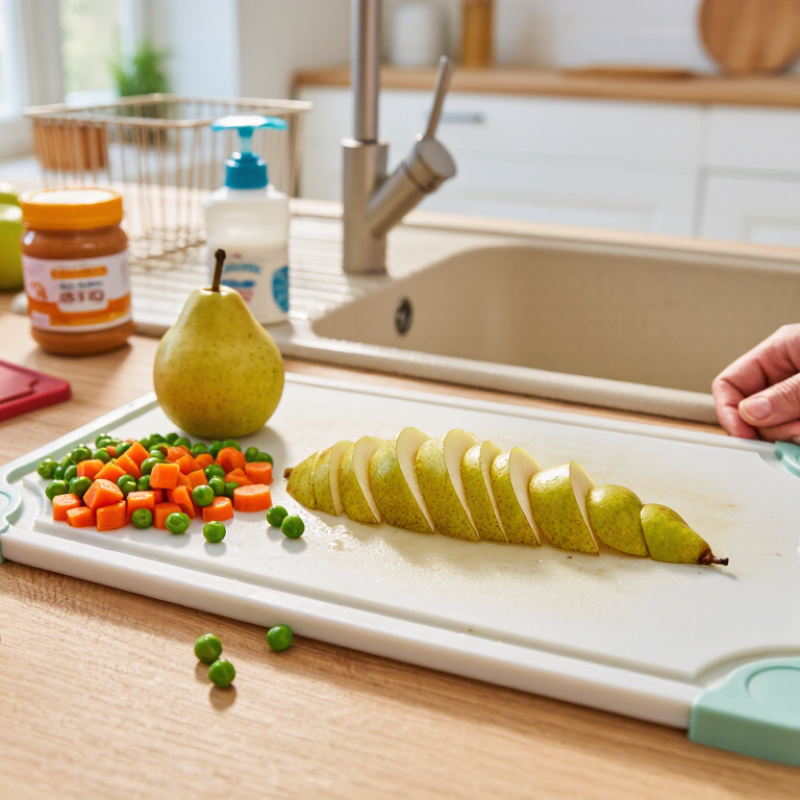
How Plastic Cutting Boards Are Used for Preparing Baby Food
Is It Safe to Cut Baby Food on Plastic Cutting Boards?
Plastic boards can be used to prepare baby food when they are clean, intact, and made for food preparation. Use a separate board for raw meat, poultry, or fish, and keep it away from ready-to-eat ingredients such as cooked vegetables. A stable board also helps prevent slips while you mash soft foods or dice fruit into small pieces.
Wash the board with hot, soapy water after each use, rinse it well, and let it dry fully. Follow the care instructions if you plan to put it in a dishwasher. Deep knife grooves can trap food residue, so replace a board that is heavily scored or difficult to clean. Keep it simple. It is easy to focus on the board and forget the knife handle or spoon, which can also transfer germs. Wash those tools, too. Prepare small portions, then refrigerate leftovers promptly in a clean, covered container.
Tips: Use a light-colored board to spot residue more easily. Keep one board for produce and cooked foods, and another for raw animal products. Check the surface before preparing each meal. If it feels rough or shows deep cuts, choose another board.
Potential Safety Concerns When Cutting Baby Food on Plastic
Plastic cutting boards are light, easy to wash, and common in busy kitchens. But knife marks can hold food residue, making thorough cleaning harder. The USDA Food Safety and Inspection Service advises replacing cutting boards with excessive wear or grooves that are difficult to clean. That matters when preparing baby food, which may be served without further cooking.
A 2023 study in Environmental Science & Technology estimated that chopping on polyethylene boards could release 14.5–71.9 million microplastic particles per person annually; its estimate for polypropylene boards was 49.5 million.
These figures were extrapolated from laboratory testing, not measured exposure in infants. Researchers have not established what these particles mean for health. The uncertainty matters. I would avoid presenting the estimates as proof that plastic boards are unsafe.
Wash boards promptly with hot, soapy water, and use a separate clean surface for ready-to-eat foods after handling raw meat. Grooves matter. If a board stays stained or feels rough, replacing it is a sensible precaution, especially before finely chopping soft fruit or vegetables for a baby.
How Board Condition and Cleaning Affect Food Safety
A plastic cutting board can be suitable for preparing baby food, but its condition matters. USDA guidance says boards with deep knife grooves can be difficult to clean and should be replaced when worn. Run a fingertip across the surface: if cuts catch crumbs or stay visibly discolored after washing, choose a smoother board. Tiny details matter. A board that looks clean may still hold food residue in its grooves.
Wash the board with hot, soapy water after cutting produce, meat, or other ingredients, then rinse and let it dry fully. Use a dishwasher only if the board is labeled dishwasher-safe. Keep raw meat separate from ready-to-eat foods, including fruit destined for a baby’s meal. The FDA Food Code calls for food-contact surfaces to be maintained in good repair and cleaned as needed. CDC estimates that foodborne illnesses affect about 48 million people in the United States each year; that figure covers all ages, not baby-food preparation specifically. The number is sobering, though it cannot tell us the risk from one board. USDA: “Cutting Boards and Food Safety”; FDA: 2022 Food Code; CDC: foodborne illness estimates.
Is It Safe to Cut Baby Food on Plastic Cutting Boards?
How board condition and cleaning affect food safety
Cleaning guidance: USDA guidance for sanitizing food-contact surfaces is 1 tablespoon of unscented liquid chlorine bleach per gallon of water. Follow the product label, and never mix bleach with other cleaners.
Plastic boards can be used for baby food when they are clean and in good condition. Wash with hot, soapy water after use; use a dishwasher only if the board’s care instructions allow it. Replace boards with deep grooves that are difficult to clean.
Source: USDA Food Safety and Inspection Service, cutting-board cleaning and sanitizing guidance.
How to Choose and Maintain a Plastic Cutting Board
Is It Safe to Cut Baby Food on Plastic Cutting Boards?
How to Choose and Maintain a Plastic Cutting Board
A plastic cutting board can be suitable for preparing baby food when it is clean, intact, and used carefully. Choose a sturdy board labeled for food contact, with a smooth surface that stays stable on the counter. A light-colored board can make food residue easier to spot. Avoid boards with cracks, rough patches, or deep knife grooves. Small details matter.
Use a separate board for raw meat and ready-to-eat foods, such as soft fruit or cooked vegetables. This helps reduce the chance of transferring germs. Wash the board with hot, soapy water after each use, then rinse and let it air-dry fully. A quick rinse is tempting, but it does not remove grease or food residue reliably. Follow the board’s care instructions before putting it in a dishwasher; not every plastic board is designed for high heat.
Inspect the surface regularly, especially after chopping firm foods. Replace the board if cuts become deep enough to trap food or if it warps and rocks under a knife. A little staining may look unpleasant, but damage matters more. Wash your hands and clean nearby utensils, too. The board is only one part of a safe preparation routine.
Is It Safe to Cut Baby Food on Plastic Cutting Boards? - How to Choose and Maintain a Plastic Cutting Board
| Topic |
Practical guidance |
What to look for |
| Is it safe for baby food? |
A clean, intact plastic cutting board intended for food contact can be used to prepare baby food. Safe handling and thorough cleaning matter more than the board’s color or appearance. |
Choose a board labeled or documented as suitable for food contact. Avoid boards that are cracked, warped, or difficult to clean. |
| Plastic type |
Food-contact cutting boards are commonly made from plastics such as high-density polyethylene (HDPE) or polypropylene (PP). Material alone does not guarantee safe use; follow the product’s care instructions. |
Look for a clear food-contact designation and care instructions. Avoid using unidentified plastic sheets or containers as cutting boards. |
| Preventing cross-contamination |
Keep raw meat, poultry, and seafood separate from produce and cooked or ready-to-eat foods. Use separate boards when possible, or wash and sanitize the board before switching food types. |
A second board, or clearly designated sides, can help keep raw animal foods apart from foods that will be served without further cooking. |
| Cleaning after use |
Wash promptly with hot, soapy water, rinse, and air-dry or dry with a clean towel. Follow the board’s instructions before putting it in a dishwasher. |
Dishwasher-safe boards can be cleaned in a dishwasher according to their care label. Do not assume every plastic board is dishwasher-safe. |
| Sanitizing when needed |
After contact with raw meat, poultry, or seafood, sanitize the cleaned board using a food-contact-safe method and follow the sanitizer label’s dilution and contact-time directions. |
Use only a sanitizer suitable for food-contact surfaces. Never mix bleach with other cleaners, and follow the product label. |
| Scratches and replacement |
Repeated knife cuts can create grooves that are harder to clean. Replace a board when it has deep grooves, cracks, or damage that prevents thorough cleaning. |
Inspect the surface regularly. A board does not need to be replaced for ordinary shallow marks if it remains intact and can be cleaned well. |
| Before preparing produce |
Wash fresh fruits and vegetables under running water before cutting, even if the peel will be removed. Clean the board and knife before preparing cooked or ready-to-eat baby food. |
Do not wash produce with soap or household detergent. |
| Storage and everyday care |
Let the board dry fully before storing it. Store it in a clean, dry place, and avoid placing it near heat unless the manufacturer says it is heat-resistant. |
Keep the board from contacting dirty sinks, counters, or utensils after cleaning. |
When to Replace a Plastic Board or Choose Another Surface
A plastic cutting board can be suitable for preparing baby food when it is clean, intact, and used carefully. The main concern is not the word “plastic,” but damage that makes thorough cleaning difficult. Wash the board with hot, soapy water after each use, and follow its care instructions. Keep it separate from surfaces used for raw meat, or clean it thoroughly before preparing ready-to-eat foods.
Replace the board if it has deep grooves, cracks, rough patches, or edges that are splitting or curling. These spots can hold food residue and are harder to scrub clean. A lingering smell after washing is another reason to inspect it closely. A surface stain alone does not always mean the board is unsafe, but damage matters more. Small knife marks add up. It is easy to keep using a familiar board longer than you should.
A smooth, undamaged board is usually the practical choice for chopping soft fruit, cooked vegetables, or other baby-food ingredients. If yours is worn, choose a new plastic board or a well-maintained, food-safe wood board that can be cleaned and dried fully. Glass may seem easy to wipe, but it can be slippery and hard on knives. No surface fixes poor cleaning; check the board before each use, especially after a rushed meal prep.
Conclusion
Is it safe to cut baby food on plastic cutting boards? In general, a clean, food-safe plastic board in good condition can be used to prepare ingredients for babies. The main concerns are not plastic boards alone, but deep cuts and grooves where food residue and bacteria may remain, as well as cross-contamination from raw foods. Wash the board thoroughly with hot, soapy water after each use, and dry it completely. Use separate preparation surfaces for raw meat and ready-to-eat foods when possible, and clean knives and utensils between tasks.
Choose a sturdy board that is easy to wash and inspect it regularly. If it is heavily scored, cracked, warped, or difficult to clean, replace it rather than continuing to use it. A smooth, well-maintained plastic board can be a practical option, while another food-safe surface may suit your routine better. Careful cleaning, safe handling, and timely replacement help keep baby food preparation hygienic.
 Chef Base Kitchen
